

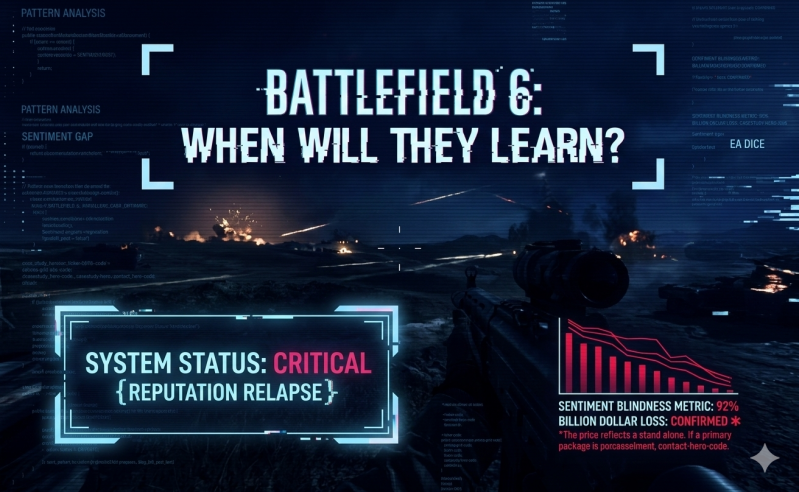
The 2042 Post-Mortem and the Growing Cost of Sentiment Blindness.
The Battlefield franchise illustrates a broader business reality: when companies treat customer sentiment as a crisis response instead of a continuous metric, reputation risk compounds quickly.
After the Battlefield 2042 catastrophe, we witnessed a rare moment of corporate humility. EA/DICE spent years in the trenches, listening to the community and clawing back a "failed" game until it nearly hit its original quotas. It was a masterclass in reputation recovery.
But as Battlefield 6 begins its lifecycle, a familiar, dangerous pattern has emerged. Despite a strong launch, the signal is being lost again. The devs have stopped listening, and the "Sentiment Gap" is widening.
The Intelligence Briefing
When Silence Becomes a Reputation Risk: The Battlefield 6 Warning
In digital markets, reputation doesn’t collapse overnight. It collapses when organizations stop listening.
The launch of Battlefield 6 initially felt like a turning point. After the disastrous rollout of Battlefield 2042, developers appeared to have finally reconnected with their community. Communication improved. Feedback loops reopened. Players felt heard.
But recent sentiment data suggests something troubling: The conversation is fading again — not from the players, but from the developers. In reputation systems, silence is rarely neutral.
1. The “Ghosting” of the Community
One of the most dangerous things a brand can do after a recovery is disappear from the conversation that saved it. The Battlefield community helped rescue 2042 from becoming a permanent failure. Developers responded, patches addressed core complaints, and the relationship between studio and players began to stabilize.
Now that momentum appears to be reversing.
When companies stop responding to feedback after a “win,” communities don’t just get louder. They disengage. Disengagement is far more dangerous than criticism.
A loud community can still be recovered.
A silent one has already moved on.
2. The Billion-Dollar Memory Hole
How does a company forget a billion-dollar lesson?
By treating reputation as a crisis response, instead of a core operational metric.
When 2042 collapsed, DICE was forced to listen. Player sentiment shaped updates, communication increased, and the studio demonstrated that it could adapt under pressure.
But ignoring early feedback around Battlefield 6 signals a familiar pattern returning: Design by ego instead of design by intelligence.
Organizations that treat feedback as optional eventually rebuild the same conditions that caused their last crisis.
Despite FOUR studios contributing to the franchise, developers recently cited team size limitations when explaining why new maps (A long player criticism they promised to work on A YEAR AGO) cannot be delivered faster. For a community that watched layoffs follow the Battlefield 2042 collapse, the message lands poorly.
3. The ROI of Listening
The recovery of Battlefield 2042 wasn’t just a PR victory. It was financial survival.
By responding to player sentiment, EA transformed what could have been a permanent franchise collapse into a product that continued generating revenue and player engagement. That recovery proves something most companies still misunderstand: Listening to customers is not reputation management. It’s revenue protection.
The Battlefield franchise has developed a pattern that players now recognize: launch controversy, defensive messaging, community backlash, and eventual course correction months later. By the time developers start listening, the damage is already done. The problem isn’t that the studio can’t recover — Battlefield 2042 proved it can. The problem is that the same lesson keeps needing to be learned again.
Quotes: Developers believing they know better than the community.
“We know you think you don’t want it, but trust us — you do.” - Blizzard Entertainment: Diablo III
“We knew this game would have bumps in the road.” - Todd Howard discussing the launch of Fallout 76
“Players will realize that the auction house is actually the safest and most efficient way to trade.” - Jay Wilson: Diablo III
“Every character you meet is another real person.”- Todd Howard discussing the launch of Fallout 76
“Gamers have to get comfortable with not owning their games.” - Philippe Tremblay Ubisoft
“Do you guys not have phones?” - Wyatt Cheng Blizzard Entertainment: Diablo Immortal
“It runs surprisingly well on last-gen consoles.” - CD Projekt Red: Cyberpunk 2077
“The story is in the Grimoire.” - Bungie: Destiny 2
“We need to remove content so the game can grow.”- Bungie: Destiny 2
“The intent is to provide players with a sense of pride and accomplishment.” - EA defending Microtransactions: Star Wars Battlefront II
“It just works.” - Tod Howard: Fallout 76
“Fortunately we have a product for people who aren’t able to get some form of connectivity. It’s called Xbox 360.” - Microsoft XBOX on their "always online" policy
“Consumers are ready for higher prices.” - Take-Two Interactive
“Live services allow us to engage players for a longer period of time.” - Andrew Wilson EA
“Accept it, or don’t buy the game.” - DICE Studios: Battlefield 5
The pattern is hard to miss.
When communities push back on controversial decisions, developers often respond with confidence instead of curiosity or empathy.
Months later, the same systems are patched, redesigned, or quietly removed. The worst part is normal companies and businesses do this same thing. They hope their clients, customers, and business relations forget what they said. Battlefield 6 is just another company caught in the cycle and a perfect case study to show off why reputation matters.
The Real Risk
Ghosting the community now risks triggering a second collapse. Trust behaves differently than software. You can patch bugs overnight. You cannot patch trust after it’s deleted.
The mindset isn’t unique to Battlefield. During the backlash surrounding Diablo III’s controversial systems, developers famously dismissed criticism with the belief that players would eventually understand the design decisions. They didn’t. The system was later removed entirely.
History keeps repeating the same lesson: customers are remarkably good at identifying problems — and organizations are remarkably good at ignoring them.
The Bottom Line
Companies like EA and DICE illustrate a core reality of modern markets: Sentiment blindness is a choice.
If you stop listening to the people who fund your business, no amount of technical brilliance can protect the outcome. Battlefield 6 is approaching a crossroads.
- Will the studio honor the lesson learned during the recovery of 2042?
- Or will silence do what bugs and bad launches could not: Quietly end one of gaming’s biggest franchises.
The gaming industry has a long history of developers insisting that players “just don’t understand the vision.” Diablo III proved how that story ends. The feature players rejected the most was eventually removed entirely. Trust isn’t built by proving customers wrong. It’s built by proving you listened.
About ReviewLine
ReviewLine exists to help organizations detect reputation risk before it becomes a crisis. The most expensive failures rarely start with bad products. They start when companies stop listening.
Our owner and analysts love the Battlefield franchise, but being in this business, and seeing that EA/Dice has not learned has been a topic of debate lately in the office. We make these blogs not to just "Call-out" the big issues that relate to what we do, but to also show how one major company can make an impact on their customers. We want to help every business that has this issue, not just EA/Dice. We are just a small start-up, but we have the best team on standby when you are ready.
Sources:
EA wants to make the BEST BATTLEFIELD The world has seen: Using Player Sentiment and Feedback
EA Says that "They Will NOT Allow This To Happen Again
BATTLEFIELD 6 DELAYED: The Devs want to review feedback first.
Battlefield 6 Lead Producer Comes Back From Vacation To Find A Long List of Issues
BF6 Devs Forced into Tactical Retreat After Massive Fan Backlash Over “COD-Style” Skins
VIDEO: Battlefield 6 still isn't listening to the players. - March 3rd 2026
Battlefield 6 Faces Player Outrage After Turning $50 Skins Free in Just One Week
Battlefield 6 producer says devs can't make new maps faster because "we’re a team of a certain size"
ReviewLine Reputation: The Gaming Industry Achilles Heel.